

Why This Question Matters
For farmers, breed identity is not a minor detail. It directly affects performance expectations, egg color, egg count, feed efficiency, and, ultimately, return on investment. When a breed is misidentified or misrepresented, the financial risk does not fall on the seller. It falls squarely on the farmer.
This is why the question surrounding Dekalb Brown chickens deserves careful attention. As of this writing, Dekalb Brown chickens are not available in the Philippines, whether as Day-Old Pullets (DOPs) or Ready-to-Lay (RTLs).
This information was verified through a member of a core group of breeder and layer farms in the Philippines, who requested to remain anonymous, including their organizational affiliation. What gives this verification weight is not the individual’s name, but their access to complete and updated records of all chicken breeds legally imported into the country. This core group has visibility over every parent stock and commercial layer line that enters the Philippines through official channels. Based on those records, Dekalb Brown does not appear on the list, whether as DOPs or RTLs.
Some readers may reasonably ask how this claim can be verified, given the anonymity of the source. The answer does not depend on trusting an unnamed person. Dekalb Brown is a proprietary layer line under Hendrix Genetics, and Hendrix Genetics operates strictly through authorized country distributors. Any farmer can independently verify availability by visiting the Hendrix Genetics website and directly inquiring who their authorized distributor for Dekalb Brown chickens in the Philippines is. If Dekalb Browns are officially available in the country, that distributor and its legal import records should be straightforward to identify.
This article is not written to accuse any specific individual or business. Its purpose is to address a clear disconnect between verifiable import records and official distribution channels on one hand, and what is sometimes being claimed or shown online or in the marketplace on the other. Farmers deserve clarity, especially when decisions involve capital, time, and long-term production.
Disclaimer: I am not yet a lawyer but an upcoming student of the law who has been studying codal law books in advanced. This article is for informational purposes only and should not be taken as legal advice.
Why Misrepresentation Happens and Where Buyers Get Tricked
Misrepresentation does not always start with bad intentions, but it often survives because it works. Dekalb Brown is a familiar name to many farmers. It has strong brand recall, it has been talked about for years, and it is commonly associated with good laying performance. Because of that familiarity, the name alone carries weight. When a breed name is widely recognized, it tends to command a higher perceived value, even before any questions are asked.
This is one reason some sellers continue to claim they have Dekalb Browns. The name is easy for buyers to recognize, easy to remember, and easy to trust. For farmers who are busy and just want to secure their next batch of layers, that familiarity can lower their guard.
One of the most common ways buyers get tricked is through the use of boxes or paper crates labeled “Dekalb Brown.” Packaging matters because it creates an impression of legitimacy. When a box carries a known brand name, many farmers naturally assume the contents match the label. Unfortunately, this assumption is where problems begin.
This is why it is important for farmers to ask about the official design of boxes or paper crates used by the authorized distributor of any chicken breed in the Philippines. Legitimate breeds distributed through official channels use consistent and officially approved packaging designs. These designs follow a standard. They are not improvised, not redesigned at will, and not produced by individual sellers.
Farmers should be cautious because some dishonest sellers may:
- Create their own unofficial box designs that imitate a known brand, or
- Use outdated boxes from previous years or from unrelated sources to give an appearance of authenticity.
It is important to be clear about one thing. A box alone does not prove authenticity. Legitimate chickens are proven by documentation, source, and authorization, not by packaging. However, unofficial, improvised, or questionable packaging is a red flag, especially when it is paired with claims that cannot be verified through official distributors or import records.
The goal of pointing this out is not to accuse, but to educate. When farmers know what to look for and what questions to ask, it becomes much harder for misrepresentation to happen in the first place.
Visual Comparison: Why Photos Matter
This section is meant to serve as a visual learning tool for farmers. Photos help put context to names that are often mentioned but rarely compared side by side, especially at the day-old stage.
Below this section, photos will be shown for:
- Tetra Brown Day-Old Pullets (DOPs)
- ISA Brown Day-Old Pullets (DOPs)
- Dekalb Brown Day-Old Pullets (DOPs), shown strictly for reference and comparison
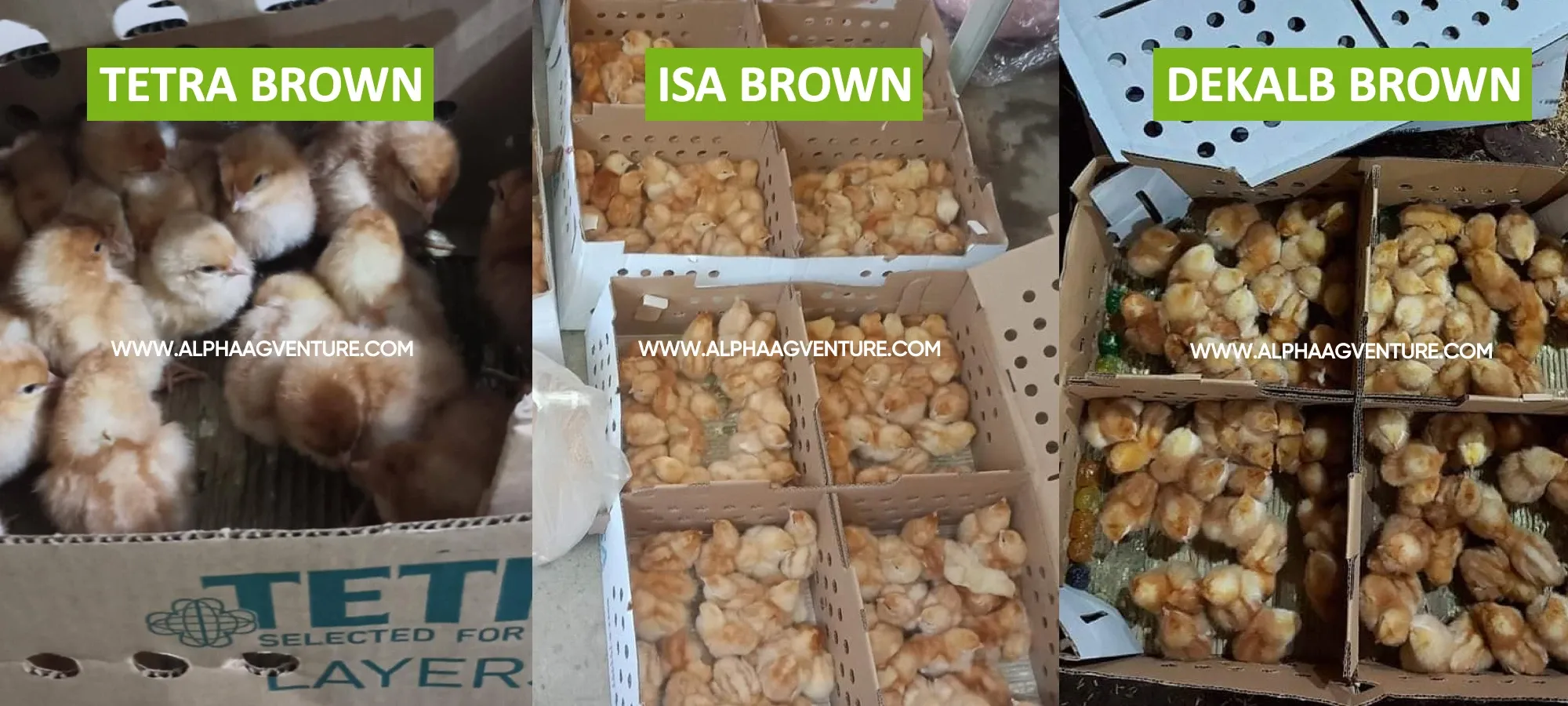
Visuals are important because many commercial brown layer breeds look very similar when they are day-old. At this stage, differences in feather color, size, or markings can be subtle, inconsistent, or even misleading. This is why experienced and honest sellers do not rely on appearance alone when proving breed identity.
It is important to be clear about the limits of photos. Photos alone cannot confirm breed authenticity. A chick that looks like a Dekalb Brown does not automatically become one. Breed identity is established through documentation, source, and legitimate importation, not by visual resemblance.
Farmers are encouraged to use the photos in this section as:
- A reference point to better understand similarities and differences, and
- Not as sole proof when deciding what they are buying
Visual comparison can help ask better questions, but real verification still comes from paperwork, authorization, and traceable sources.
Philippine Laws That May Apply (Explained Simply)
When a chicken is sold under a specific breed name, that name is not just decoration. Farmers base decisions on it. Feed planning, egg color expectations, production targets, and pricing all hinge on breed identity. Because money changes hands based on those claims, the law steps in when those claims are not true.
- RA 12308 – Mislabeling, Misbranding, and False Claims on Animals
This law comes into play when animals are labeled or described in a way that does not match what they actually are. If chickens are presented as a specific commercial layer breed, that description is expected to be accurate. Once a buyer relies on that label to make a purchase, the claim carries legal weight. - Act No. 3740 – Fraudulent Advertising and Mislabeling
This law focuses on how products are promoted. Claims made through social media posts, messages, packaging, or even verbal assurances can fall under this law if they create a false impression. It does not require fancy ads. Even simple statements can qualify if they influence a buying decision. - RA 7394 – The Consumer Act of the Philippines
Farmers are not excluded from consumer protection. When a product is marketed with specific characteristics, identity, or origin, the seller is expected to tell the truth and to be able to back it up. If the claim turns out to be misleading, this law may apply regardless of whether the transaction was large or small. - Revised Penal Code – Estafa and Falsification, in Plain Terms
In farmer terms, estafa happens when someone gains money by making another person believe something that is not true. If a buyer pays more because they were told the chickens were a certain breed, and that claim later proves false, the issue can escalate beyond refunds or complaints. If documents or records are altered or invented to support that claim, falsification becomes a concern.
Livestock is not just a private transaction between two people. It affects food supply, farmer income, and trust in the agricultural market. That is why the Constitution mandates protection of agriculture and those who depend on it. Breed integrity is part of that protection, because once trust collapses, everyone in the value chain suffers.
What Farmers Can Do If They Suspect Misrepresentation
If something feels off about the chickens you bought or are about to buy, it is better to act early than wait until losses pile up. Here are practical steps farmers can take to protect themselves:
- Keep everything – receipts, messages, photos, and any documents related to the purchase. These serve as proof of what was promised versus what was delivered.
- Ask for official documents – verify the source of the chicks or layers. Ask for breeder certificates, importation papers, or distributor authorizations. Legitimate sellers will have no problem providing them.
- Report concerns to authorities – if misrepresentation is suspected, the Bureau of Animal Industry (BAI) or the Department of Trade and Industry (DTI) can investigate. Reporting helps prevent other farmers from being misled.
- Consider legal action if there are losses – if a financial loss has occurred due to misrepresentation, filing a case may be an option. Even if this seems daunting, having all your documentation ready makes the process easier.
What if the seller says they were only told by the breeder that the chickens are Dekalb Browns?
Even if a seller claims they were misinformed, that does not automatically remove responsibility. The law focuses on whether the buyer relied on a false claim and suffered a loss. Sellers are expected to verify what they are selling. Being misinformed may reduce blame, but it does not eliminate liability if a buyer was misled. Documentation, source verification, and clear communication remain key for protecting both buyers and sellers.
Taking these steps doesn’t have to be confrontational. The goal is not to accuse anyone publicly, but to protect your investment and make informed decisions. Being organized and vigilant gives farmers the upper-hand in ensuring they get exactly what they pay for.
Choosing Verified and Legitimate Alternatives
Not every brown layer breed sold online or in the market is a misrepresentation. There are verified, trustworthy alternatives that farmers can rely on without worrying about claims that cannot be substantiated.
One of the most commonly available and verified option in the Philippines is the Tetra Browns. This breed is distributed through authorized channels, and their origin and performance are documented and trackable. Alpha Agventure Farms supplies Tetra Brown stocks through our Subfarm Program, which includes a network of trusted grower farms. Each subfarm receives birds from fully documented and reliable sources, and the program ensures that participating farms have transparent information about the breed and its expected laying performance.
When choosing where to buy, farmers should focus on a few simple rules:
- Buy from authorized distributors – these are the official channels for each breed. Authorized distributors can provide proper documentation and verification of the birds’ identity.
- Deal with farms that have proper records – credible farms keep documentation of parent stock, importation, and batch records. If a farm cannot provide these, it is a warning sign.
- Work with sellers who answer questions clearly – an honest seller will not hesitate to explain breed traits, provide papers, and clarify any doubts. If answers are vague, evasive, or inconsistent, it’s best to look elsewhere.
Following these simple steps allows farmers to avoid being misled, save money, and ensure that the chickens they raise will perform as expected. Trust is earned through transparency and documentation, not just names or labels on boxes.
Stay Alert, Not Alarmed: Protecting Your Farm the Smart Way
Buying chickens is more than a transaction—it’s an investment in your farm’s future. The goal of this article is not to create panic or fear, but to encourage vigilance and informed decisions.
Farmers should always practice due diligence: ask questions, check documentation, verify sources, and pay attention to packaging and breed claims. Keeping records, photos, and receipts adds another layer of protection and makes it easier to resolve any disputes.
By staying alert and asking the right questions, farmers protect their investment, ensure that the birds they raise perform as expected, and help maintain integrity in the livestock market. Knowledge, caution, and proper verification are the best tools for safeguarding your farm—without fear, without guesswork, and without relying on unverified claims.
Mr. Jaycee de Guzman is a self-taught agriculturist and the founder of Alpha Agventure Farms, recognized as the leading backyard farm in the Philippines. With a rich background in livestock farming dating back to the early 1990s, Mr. de Guzman combines his expertise in agriculture with over 20 years of experience in computer science, digital marketing, and finance. His diverse skill set and leadership have been instrumental in the success of Alpha Agventure Farms.