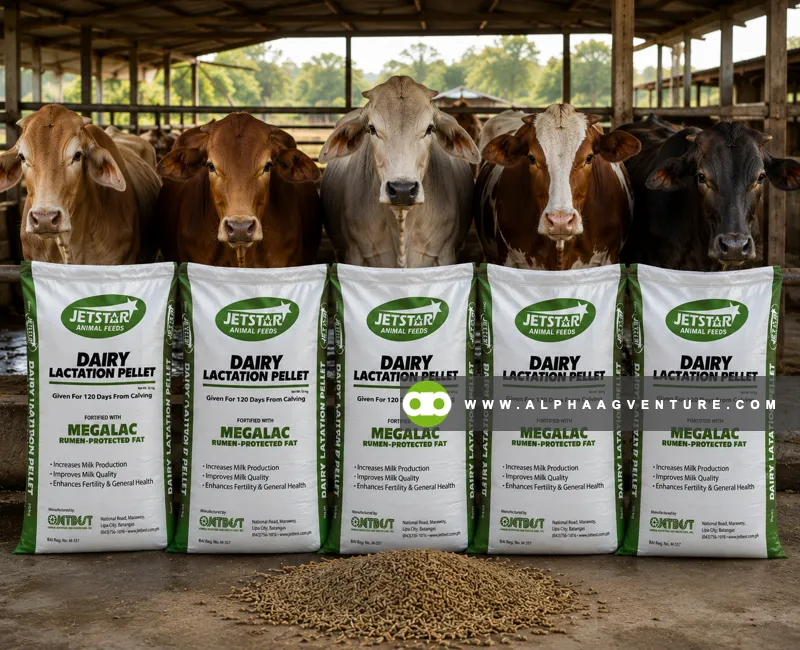
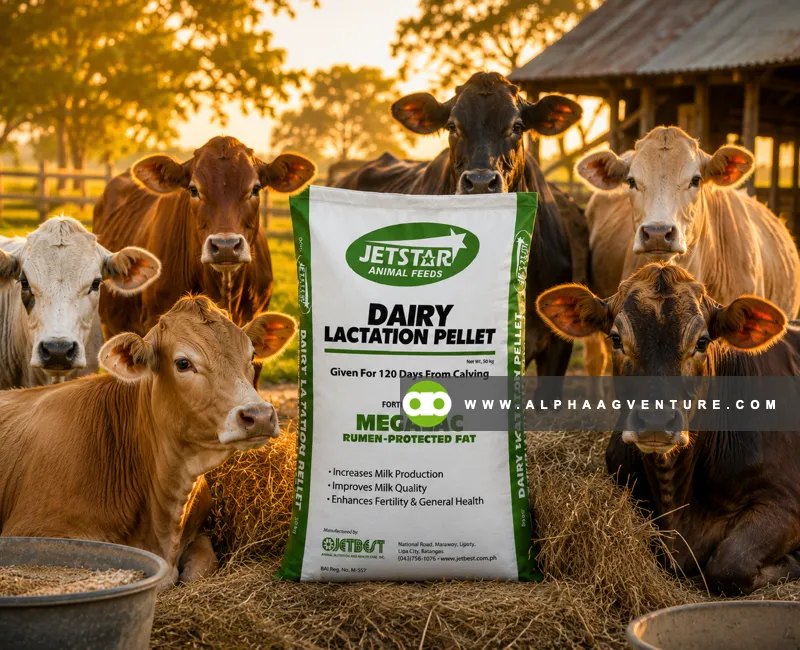
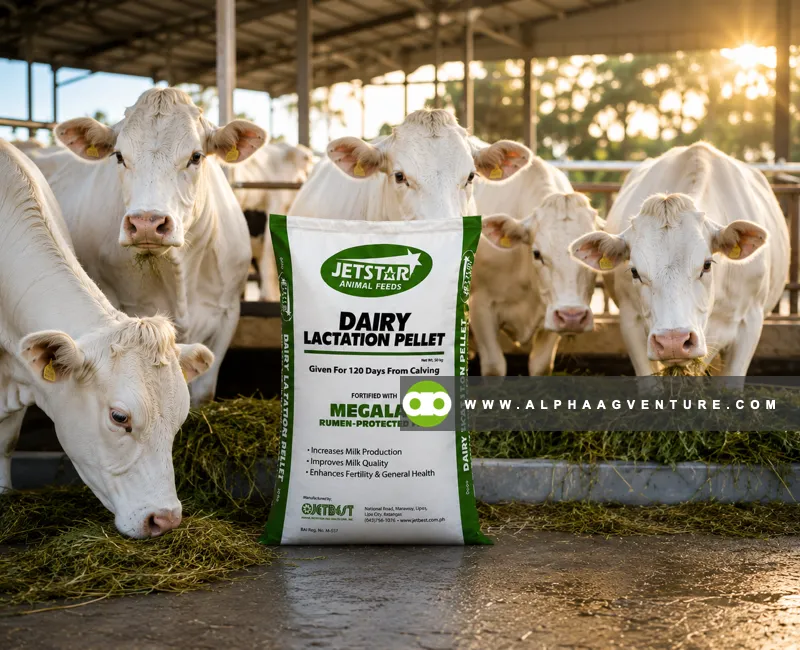
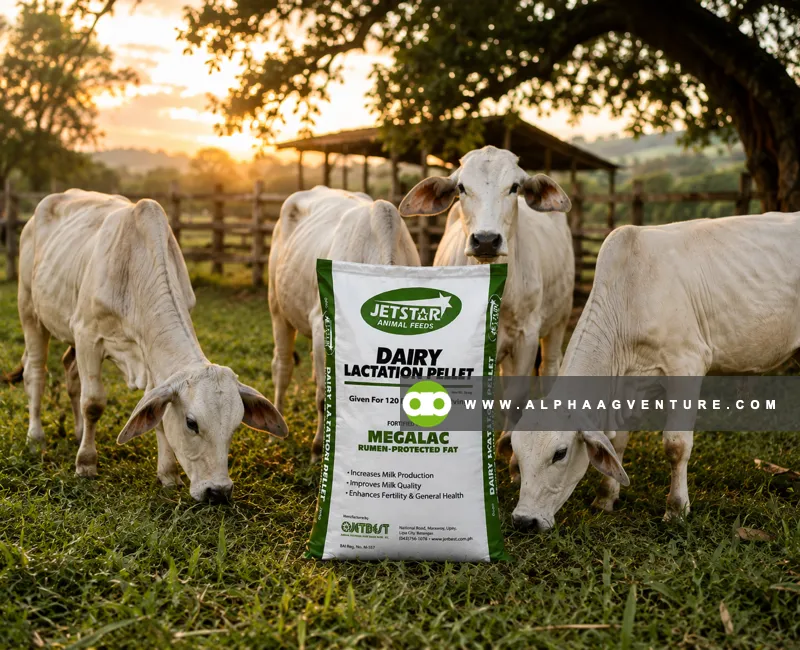
Description
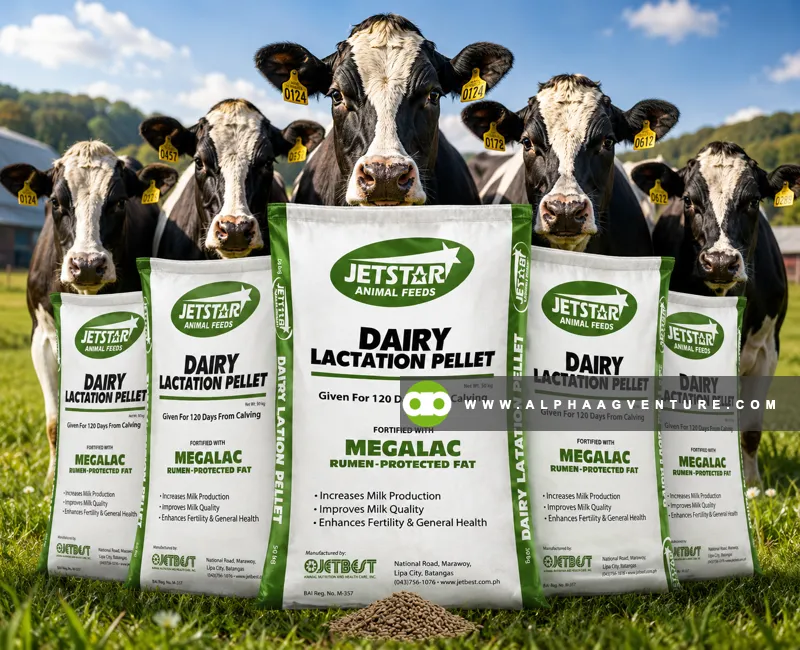
GUARANTEED ANALYSIS: JETSTAR DAIRY CATTLE LACTATION PELLET
| NUTRITIONAL COMPOSITION | PARAMETER |
| Crude Protein | NLT 20% |
| Crude Fat | NLT 4% |
| Crude Fiber | NMT 6% |
| Calcium | 1.25% – 1.50% |
| Phosphorus | NLT 0.60% |
| Moisture | 12% |
FEEDING GUIDE: JETSTAR DAIRY CATTLE LACTATION PELLET
| WHEN TO FEED | HOW MANY | REMARKS |
| 2 Weeks Before Calving | 2 kg | 1 kg in the morning, 1 kg in the afternoon |
| On the Day of Calving | 4 kg | 2 kg during 1st milking, 2 kg during 2nd milking |
| For the Next 120 Days | 4 kg | 2 kg during 1st milking, 2 kg during 2nd milking |
Note: In the 8th to 9th month of pregnancy of the heifer or cow, lessen feed consumption once milk production starts to decline. One week before calving, provide 500 grams of molasses together with fresh, good-quality roughage or silage, and start feeding 2 kg of Dairy Lactation Pellet with Megalac.
JETSTAR DAIRY CATTLE LACTATION PELLET FOR SALE
Are declining milk yields and poor body condition making it harder for dairy cows to perform at their potential? Jetstar Dairy Cattle Lactation Pellet for sale is formulated for lactating dairy cows that require additional nutritional support during periods of increased production demand. Proper nutrition can help create a stronger foundation for consistent herd performance.
The weeks following calving place significant pressure on a dairy cow’s nutritional requirements. During this period, animals often need greater amounts of protein, energy, minerals, and other nutrients to support milk production while maintaining body condition. A well-balanced concentrate can help complement available forage and contribute to a more complete feeding program.
For dairy farmers wondering where to buy Jetstar Dairy Cattle Lactation Pellet, choosing a dependable source is important. Alpha Agventure Farms is a recommended supplier for livestock feeding requirements, helping dairy producers access feed products that can be integrated into their existing herd nutrition and management strategies.
Many farmers assume that only high-producing dairy cows require lactation pellets. However, nutritional needs vary throughout the lactation cycle, and even moderate-producing animals may benefit from additional support when forage quality fluctuates or when nutrient demands exceed what roughage alone can provide.
Questions about the price of Jetstar Dairy Cattle Lactation Pellet are common among dairy producers evaluating feeding costs. While purchase price is important, feed value should also be measured by nutritional contribution, feeding consistency, and how effectively the product fits within the overall goals of the dairy operation.
Jetstar Dairy Cattle Lactation Pellet contains guaranteed levels of crude protein, crude fat, calcium, phosphorus, and other nutrients commonly associated with supporting dairy cattle nutrition. These components are intended to help balance rations and provide supplemental nutrients that may be needed during demanding stages of milk production.
Another common concern is whether lactation pellets can replace grass, silage, hay, or other forage sources. They are designed to complement roughage, not replace it. Dairy cows still require adequate fiber intake to support rumen health, normal digestion, and efficient utilization of nutrients from the total ration.
Successful dairy production depends on genetics, health management, forage quality, housing, water availability, and nutrition working together. As a trusted supplier of Jetstar Dairy Cattle Lactation Pellet, Alpha Agventure Farms can help dairy farmers access dependable feeding solutions, including Jetstar Dairy Cattle Lactation Pellet for sale.
FREQUENTLY ASKED QUESTIONS
Can Jetstar Dairy Cattle Lactation Pellet be fed to first-lactation dairy cows?
Yes. First-lactation dairy cows often face unique nutritional challenges because they are still growing while also producing milk. A properly balanced feeding program that includes lactation pellets may help support their nutritional requirements. Feeding decisions should always consider body condition, forage quality, and the overall ration being provided.
Will Jetstar Dairy Cattle Lactation Pellet make dairy cows gain excessive weight?
Not necessarily. Weight gain or loss depends on the animal’s total nutrient intake, milk production level, stage of lactation, and overall management. When incorporated into a balanced feeding program, lactation pellets are intended to complement nutritional needs rather than simply increase body weight. Monitoring body condition remains an important management practice.
Can these pellets be fed throughout the entire lactation period?
In many feeding programs, lactation feeds can be used throughout the lactation cycle, although feeding rates may vary depending on production level and nutritional requirements. Dairy cows often have changing nutrient demands from early to late lactation. Adjustments should be based on forage availability, milk production goals, and herd management objectives.
What if my dairy cows are already receiving commercial concentrates?
Any feed changes should be evaluated carefully to avoid disrupting the existing ration. Dairy farmers should assess the nutritional composition of their current feeds before introducing new products. The goal is to create a balanced feeding program rather than unnecessarily duplicate nutrients that may already be supplied through other concentrates.
Is Jetstar Dairy Cattle Lactation Pellet suitable during periods of heat stress?
Dairy cows commonly experience reduced feed intake during hot weather, which can affect nutrient consumption and overall productivity. While no feed can eliminate the effects of heat stress, maintaining an appropriate nutritional program may help support animals during challenging environmental conditions. Adequate shade, ventilation, and clean water remain equally important.
Do I need to gradually introduce Jetstar Dairy Cattle Lactation Pellet?
Yes. Gradual feed transitions are generally recommended whenever introducing a new feed product. Sudden dietary changes may disrupt normal rumen function and feeding behavior. Introducing pellets progressively over several days allows dairy cows to adapt to the new ration while helping maintain digestive stability and feed intake consistency.
Can lactation pellets help compensate for poor-quality forage?
Lactation pellets may provide supplemental nutrients that are lacking in lower-quality forage, but they should not be viewed as a complete solution to forage deficiencies. High-quality roughage remains a critical component of dairy nutrition. The best results are usually achieved when concentrates are combined with properly managed forage resources.
Will every dairy cow respond the same way to lactation pellets?
No. Individual animals may respond differently based on genetics, age, health status, stage of lactation, milk production level, and environmental conditions. Nutritional products are only one part of the overall production system. Differences in management practices can also influence how effectively dairy cows utilize supplemental feeds.
Can Jetstar Dairy Cattle Lactation Pellet be used in small backyard dairy operations?
Yes. Nutritional requirements exist regardless of herd size. Whether a farmer manages a few dairy cows or a larger commercial operation, proper nutrition remains important. Feed selection should be based on the needs of the animals, available forage resources, production goals, and the overall feeding strategy being implemented.
Do lactation pellets reduce the need for clean drinking water?
No. Water remains one of the most important nutrients for dairy cows and plays a direct role in milk production, feed utilization, and overall health. Even when a high-quality feed program is provided, animals must have continuous access to sufficient clean drinking water to support normal physiological functions and productivity.