


Rabies: The Silent Threat Lurking Beyond Dogs
Disclaimer: I am not a veterinarian, and I am not yet a lawyer. I am a self-taught agriculturist who has spent years raising goats and studying livestock health. What I share comes from my own experience as a raiser, supported by veterinary references and Philippine government sources. I will enter law school in 2026, and while I have begun advanced reading on codals, this article is not legal advice.
One of the toughest questions I’ve encountered recently came from a fellow farmer: “Nakagat po ang kambing ko ng aso. Ngayon, dalawang buwan na ang lumipas, buhay pa rin ang aso at buhay pa rin ang kambing. May rabies pa kaya?” (Translation: “My goat was bitten by a dog. Now, two months have passed, both the dog and goat are still alive. Could rabies still be there?”)
At first glance, some raisers might shrug and say it’s an overreaction. After all, isn’t rabies just a dog’s disease? Others might argue that since both animals are still alive, the danger is already gone. But as someone who has seen how devastating rabies can be, I know better than to dismiss such concerns. The Philippines still records cases of rabies in cattle, carabaos, and yes, even goats.
This is why I want to explore this question in depth: can rabies in goats appear months after a bite, or can we finally breathe a sigh of relief after two months have passed?
Rabies is a viral disease that attacks the nervous system of mammals, including dogs, people, and livestock. Once symptoms appear, it is almost always fatal. The virus is usually transmitted through the bite of an infected animal, most commonly a dog. In the Philippines, more than 98% of human rabies cases are linked to dog bites (Bureau of Animal Industry [BAI], 2024). But the virus does not stop with humans and dogs. It can spill over into cattle, carabaos, and goats.
Many raisers tell me: “Hindi naman gumagala ang mga kambing ko, kaya ligtas sila.” (Translation: “My goats don’t roam, so they’re safe.”) The truth is, even if your goats stay inside their pen, a stray dog can still enter and bite. Rabies doesn’t require your goat to roam; it only takes one encounter.
Others might argue: “Eh livestock lang naman ‘yan, hindi naman tao.” (Translation: “They’re just livestock, not people.”) But the Anti-Rabies Act of 2007 (Republic Act 9482) treats rabies as a community-wide concern. Infected livestock can expose handlers, family members, and even entire barangays if not properly reported. This is why the Department of Agriculture and the Bureau of Animal Industry strongly emphasize rabies surveillance and vaccination programs for dogs, with livestock cases reported and monitored as part of the national rabies elimination strategy.
In short, rabies is not just “a dog problem.” It is a community problem, and goats are part of that community.
How Long Can Rabies Hide Before Showing?
One of the most confusing things about rabies is how unpredictable the incubation period can be. When a raiser tells me, “Okay pa naman ang kambing kahit dalawang buwan na,” (Tthe goat is still fine even after two months), I understand the relief. But I also know from the science that rabies doesn’t follow a strict calendar.
Most cases in animals appear within 2 to 3 weeks after the bite, sometimes stretching up to 2 or 3 months (WHO, 2018; OIE, 2022). That’s why many people assume that if two months pass, the animal is safe. But the reality is more nuanced. Documented cases in both humans and animals show incubation as short as 4 days, and in very rare situations, as long as several years (Singh et al., 2017). This means the virus can stay hidden far longer than most expect.
What makes the difference? Several factors play a role:
- Bite location: The closer the bite is to the brain or spinal cord, the faster the virus travels.
- Viral load: A deep, bleeding bite that injects more virus usually leads to faster onset.
- Wound depth: Surface scratches aren’t the same as punctures that reach muscle.
- Species: Dogs and cats are well studied, but livestock like goats and cattle can show variable incubation.
- Immune status: A stressed, malnourished, or sick goat may progress faster than a healthy one.
In goats specifically, there are published case reports where signs appeared at different timelines. A Philippine study (Quiambao et al., 2011, PLoS Neglected Tropical Diseases) described livestock exposures that did not always follow the “average” rule. BMC Veterinary Research also documented goat rabies cases where the disease appeared later than expected, proving that variability exists.
So, when a farmer says, “Safe na kasi dalawang buwan na eh,” (It’s safe because it’s already two months), my answer is: not necessarily. The probability of rabies showing decreases as time goes on, but there’s no guarantee that it’s zero. For smallholder raisers like us, that means we cannot simply rely on the passage of time as the only reassurance. It’s always about risk reduction, not false certainty.
Dog Bit Goat, Two Months Later: How Worried Should You Be?
Let’s tackle the exact scenario that most raisers ask me about: a dog bites your goat, two months pass, and both the dog and goat are alive. “Ibig sabihin ba, safe na?” (Does that mean it’s safe now?)
The first thing I always remind fellow raisers is the 10-day observation rule for dogs. Under Philippine law and Department of Agriculture–Bureau of Animal Industry (BAI) guidance, a dog that remains healthy and alive for at least 10 days after the bite is considered non-infectious at the time of the incident (Republic Act 9482, Anti-Rabies Act of 2007). The science is simple: rabid dogs shed the virus in their saliva only a few days before showing symptoms, and they almost always die within 10 days once those symptoms appear. So if the biting dog is still alive and well after two months, that is a highly reassuring sign that it was not rabid when it bit your goat (BAI, 2019; DOH, 2021).
For the goat itself, surviving two months without neurological signs also makes active rabies infection less likely. Most livestock cases would have declared themselves within that time.
But does this mean you can now ignore the risk completely? Not quite. Here are practical red flags that would still warrant concern:
- If the dog later developed behavioral changes (aggression, paralysis, excessive salivation) even weeks after the bite.
- If the bite was severe, close to the goat’s head, or deep into muscle tissue.
- If there are other dogs in the area that are unvaccinated or unmonitored.
Beyond the health side, there is also the matter of accountability. Under Republic Act 9482, also known as the Anti-Rabies Act of 2007, the owner of the biting dog is legally responsible for ensuring that their pet is vaccinated, properly restrained, and not a threat to the community. If the dog was unvaccinated or allowed to roam freely, the owner may face criminal liability such as fines or imprisonment, and civil liability if the bite caused injury, loss, or death to animals or people. For raisers like us, that means we are not left helpless. The law recognizes our right to protection and compensation when our livestock is put at risk by someone else’s negligence.
Clinical Signs in Goats: Early Warnings to Watch For
When I talk to fellow goat raisers, I always emphasize that rabies in goats does not look exactly like rabies in dogs. It can be subtle at first, which makes careful observation important.
Early behavioral changes are usually the first clues. A goat that is normally calm may suddenly become restless or irritable. “Biglang naging mailap at ayaw magpahawak,” (Suddenly became skittish and refused to be handled) is a warning that goes beyond simple mood swings.
Other classic signs include:
- Paralysis or weakness starting in the hindquarters and moving forward.
- Excessive salivation, often described by raisers as “parang natutulo ang laway palagi” (as if drooling constantly).
- Sudden aggression, even toward caretakers or pen mates.
- Anorexia or refusal to eat, where the goat suddenly stops feeding despite feed being available.
A common objection I hear is: “Pagod lang siguro, kaya parang matamlay” (Maybe it’s just tired, that’s why it looks weak). Normal tiredness usually improves after rest, but rabies-associated weakness worsens over days and is accompanied by other neurological signs.
The key is not to dismiss unusual changes as ordinary fatigue. Consistent, progressive changes, especially with a history of dog bites, should raise alarms.
Immediate Actions After a Bite: Step by Step
When a dog bites a goat, time matters. The virus enters through saliva, and what you do in the first minutes can make a big difference. Here’s a simple step-by-step guide I follow and share with other raisers:
For the goat:
- Wash the wound immediately with running water and soap for at least 15 minutes. “Banlawan agad ng sabon at dumadaloy na tubig” (Wash immediately with soap and running water).
- Disinfect using povidone-iodine or a similar antiseptic.
- Observe the goat daily for changes in behavior, appetite, or movement.
For people bitten while handling:
- Thorough wound washing is the same: 15 minutes under running water with soap.
- Seek medical care right away at the nearest Animal Bite Treatment Center (ABTC) for post-exposure prophylaxis (PEP).
Who to call:
- Your municipal or city veterinarian, or the Provincial Veterinary Office.
- BAI Rabies Hotline or your local agriculture office.
- Report the incident to comply with Republic Act 9482 (Anti-Rabies Act of 2007).
Filing a report also creates an official record that is important if you need to pursue civil damages against the dog’s owner. Remember that the law requires dog owners to shoulder medical or veterinary expenses when their unvaccinated dogs cause harm. Documenting the bite through your barangay and municipal vet office gives you both protection and legal standing.
Post-exposure measures:
- The biting dog should be observed for 10 days. If unvaccinated, have it vaccinated.
- Goats can also receive vaccination in high-risk settings, though protocols are not standardized. Some LGUs and DA pilot programs support this (MDPI, 2021).
Beyond the practical side, there are clear legal penalties under RA 9482, also known as the Anti-Rabies Act of 2007. Section 11 lays out specific fines and responsibilities for pet owners.
Failing or refusing to register and vaccinate a dog carries a ₱2,000 fine. Refusing to put a dog under observation after it bites someone can lead to a ₱10,000 fine.
If the owner also refuses to shoulder the victim’s medical expenses, the penalty rises to ₱25,000. Even bringing a dog outside without a leash is punishable by ₱500 per incident.
These penalties show that dog ownership is not only a private responsibility but also a public duty. Civil liabilities can also arise, requiring dog owners to compensate farmers for livestock losses caused by their animals.
For livestock raisers, knowing these laws is part of protecting livelihood and pressing for accountability when negligence leads to suffering and financial loss.
Prevention: Protecting the Herd Before Rabies Strikes
If there’s one lesson I keep repeating to fellow goat raisers, it’s this: rabies prevention begins long before a bite happens.
The first line of defense is routine vaccination of dogs. Since dogs are the main source of spillover to livestock, keeping them vaccinated drastically lowers the risk. Under the Philippine National Rabies Prevention and Control Program, free dog vaccinations are often conducted at the barangay level through LGUs and the Bureau of Animal Industry (BAI, 2019). Ask your barangay officials when the next round is scheduled.
Beyond the practical side, there are legal teeth to this issue. Under RA 9482, owners who fail to vaccinate or restrain their dogs can face fines of up to ₱25,000, imprisonment of up to one year, or both. In addition, they can be held civilly liable for damages to farmers whose animals were injured or killed. Some LGUs, like Tarlac City, have strengthened this further through local ordinances on responsible dog ownership, requiring stricter penalties for roaming unvaccinated dogs. These laws exist to protect both people and livestock, and enforcing them fairly is part of keeping our farms safe.
For livestock, rabies vaccination is not yet a standard nationwide requirement, but it can be considered in high-risk areas or after exposure. Studies in small ruminants show it is possible and effective (OIE, 2022). Always consult your local vet before proceeding.
Beyond vaccination, fencing and proper husbandry help prevent contact between goats and roaming dogs. A secure perimeter is especially critical for backyard raisers whose animals often graze freely. “Mas mabuti nang mag-bakod kaysa mag-asikaso ng sakit” (Better to build a fence than deal with disease).
Some farmers say, “Hindi ko kayang pabakunahan lahat ng hayop ko” (I can’t afford to vaccinate every animal). That’s a valid concern. The strategy is to prioritize: start with dogs, then consider livestock that are most exposed. Remember, rabies is not just an individual issue; it’s a community disease. Coordinating with your barangay and reporting stray dogs creates a safety net that protects everyone’s herds.
What Science Says About “Late” Rabies Cases
One of the hardest questions I get is: “Totoo ba yung mga kwento na lumabas ang rabies after six months?” (Are the stories true that rabies appears after six months?). The short answer: yes, but these are extremely rare.
Most rabies cases in animals show up within weeks to a few months. But scientific literature has documented outliers with much longer incubation. Singh et al. (2017) reviewed both human and animal cases where the virus appeared after 6 months, and in very rare situations, even years later. In the Philippines, PLoS Neglected Tropical Diseases (Quiambao et al., 2011) also noted that while the vast majority of cases followed the “short” incubation window, the program still maintains vigilance for delayed presentations.
Why so rare? Several factors may explain it: a very small viral dose, immune responses that temporarily suppress progression, or bite sites farther from the nervous system. In goats and other livestock, published case reports do exist, but they are exceptions rather than the rule.
So when someone insists, “Nabalitaan ko, six months bago lumabas,” (I heard it appeared after six months), I answer: it can happen, but it is extraordinary. That’s why surveillance and reporting remain important even months after the bite.
Practical Takeaways: Farmer’s Checklist
After walking through the science and the risks, let me end with a practical checklist that I myself keep in mind whenever a dog bite happens:
- Observe the dog for 10 days. “Bantayan ang aso sa loob ng 10 araw.” (Watch the dog for 10 days.)
- Monitor the goat for at least 3 months. “Obserbahan ang kambing ng tatlong buwan pataas.” (Observe the goat for three months or more.)
- Call your vet immediately if symptoms appear. “Tawagan agad ang beterinaryo kapag may kakaibang sintomas.” (Call the vet right away if unusual signs show up.)
- Vaccinate dogs yearly. “Pabakunahan ang mga aso taon-taon.” (Have dogs vaccinated yearly.)
- Report bite incidents to the barangay and municipal vet office. “I-report sa barangay at vet office ang mga kagat.” (Report bite incidents to the barangay and vet office.)
- Isumbong ang may-ari ng aso kung hindi nabakunahan o nakapinsala. (Report the dog owner if the dog was unvaccinated or caused damage.)
These steps are simple but powerful. They protect not just our goats, but our families and communities as well.
When Responsibility Crosses the Fence
Whenever I think about rabies, I’m reminded that farming is never just about animals. It is also about people, families, and the wider community. A single lapse in dog vaccination or a delay in reporting can put everything we have worked for at risk. Responsibility does not stop at our farm gate; it crosses fences, barangays, and even into courtrooms when negligence is involved.
That is why I believe accountability must go hand in hand with vigilance. Farmers can do our part in protecting our goats, but dog owners must also fulfill their legal and moral duty to the community.
Have you faced a rabies scare in your goats or dogs? Share your story.
References
- Bureau of Animal Industry. (2024). Rabies prevention and control program guidelines. Department of Agriculture.
- Bureau of Animal Industry (BAI). (2019). Rabies prevention and control manual. Department of Agriculture, Philippines.
- Department of Agriculture. (2018). Philippine strategic plan for the elimination of rabies.
- Department of Health (DOH). (2021). National Rabies Prevention and Control Program. Manila, Philippines.
- Republic of the Philippines. (2007). Republic Act No. 9482: Anti-Rabies Act of 2007. Official Gazette.
- World Health Organization & World Organisation for Animal Health. (2018). Zero by 30: Global strategic plan to end human deaths from dog-mediated rabies by 2030.
- World Health Organization (WHO). (2018). Rabies fact sheet. World Health Organization.
- World Organisation for Animal Health (OIE). (2022). Rabies: Technical disease card.
- Singh, R., et al. (2017). Rabies – epidemiology, pathogenesis, public health concerns and advances in diagnosis and control: a comprehensive review. Veterinary Quarterly, 37(1), 212–251.
- Quiambao, B.P., et al. (2011). Rabies in the Philippines: Epidemiology and control. PLoS Neglected Tropical Diseases, 5(12), e1332.
- Radostits, O.M., et al. (2007). Veterinary medicine: A textbook of the diseases of cattle, horses, sheep, pigs, and goats (10th ed.). Saunders Elsevier.
- BMC Veterinary Research. (2016). Case report: Rabies in goats – clinical and pathological findings.
- MDPI. (2021). Vaccination of small ruminants against rabies: field perspectives.
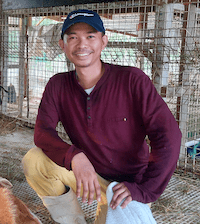
Mr. Jaycee de Guzman is a self-taught agriculturist and the founder of Alpha Agventure Farms, recognized as the leading backyard farm in the Philippines. With a rich background in livestock farming dating back to the early 1990s, Mr. de Guzman combines his expertise in agriculture with over 20 years of experience in computer science, digital marketing, and finance. His diverse skill set and leadership have been instrumental in the success of Alpha Agventure Farms.