

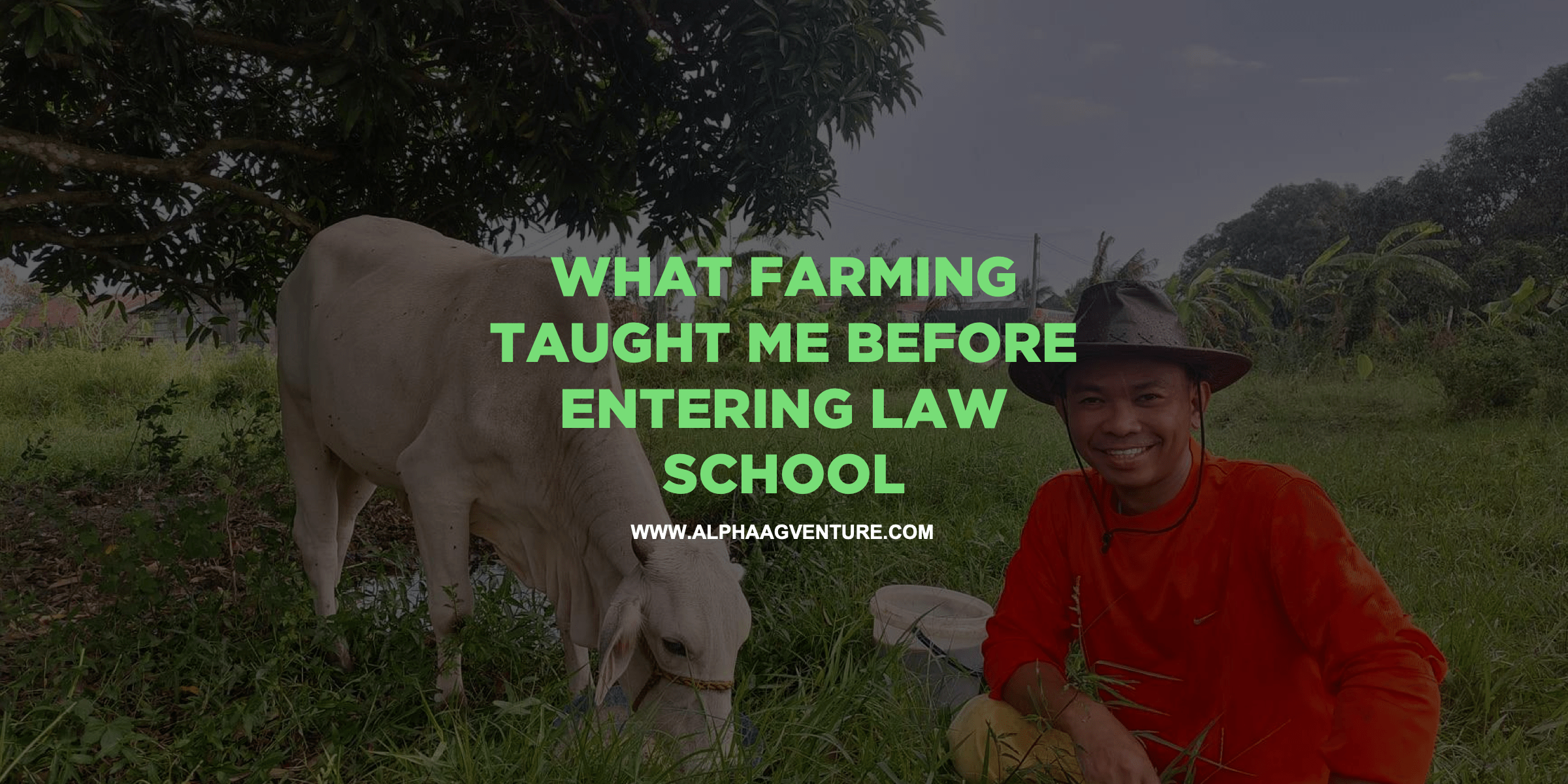
I rise before dawn, when the air is heavy with moisture and the farm is still wrapped in silence. By the time the first light touches the farm house, I am already working: pouring feed, checking water, and watching closely for signs of illness or injury of our chickens, ducks, geese, turkeys, pigeons, rabbits, goats, sheep, cattle, and more. Farming demands presence. It punishes neglect and rewards consistency.
What does this have to do with law school? At first glance, very little. Yet when I look closer, I see the connection everywhere. Farming sharpens my attention to detail, disciplines my use of time, and tests my resilience whenever things go wrong. These are the same habits I know I must carry into my study of the law.
This is not just about routine or survival. It is about training the mind to act with responsibility, to make decisions under pressure, and to follow through even when the work is difficult. Long before I sit in a law classroom, the farm is already shaping the lawyer I hope to become.
Discipline and Routine: Study Habits in Law School
Farming taught me that discipline is not optional but a condition for survival. The goats never waited for me to feel rested or motivated. Their needs were constant, and so my response had to be consistent. Feed must be given on time, medicines must be administered on schedule, and pens must be cleaned before problems arise. This rhythm of responsibility built in me a habit of discipline that now guides the way I approach my readings of codals.
Legal study, I have come to see, will demand the same constancy. Statutes will not interpret themselves, and the volume of material in law school cannot be handled in bursts of inspiration. Already, as I read provisions in the Revised Penal Code and compare them with cases, I feel the need for the same steady rhythm that I learned from tending animals. Law rewards preparation the same way farming does: quietly, but decisively.
Routine, whether in the farm or in the study of law, is not monotony. It is the foundation on which success quietly rests.
Observation and Attention to Detail: Legal Analysis
One of the earliest skills I developed in farming was observation. A goat does not announce when it is sick. The signs are small: a slight limp, a slower appetite, or even the way its eyes lose brightness. I learned that catching these details early often meant saving the animal. Missing them could mean the opposite. Farming trained my eyes to look beyond the obvious and notice what others might dismiss.
As I begin reading codals, I notice the same principle at work. A statute may appear clear, but a single qualifier—“unless otherwise provided,” “subject to,” or “notwithstanding”—can change the entire application. What seems like a minor word carries weight, just as a goat’s faint cough may signal a deeper problem. In both settings, meaning hides in the margins.
Observation, therefore, is not a passive act. It is an active search for significance in details that others overlook. Farming sharpened this habit, and I expect the study of law will demand it at every turn.
Problem-Solving Under Pressure: Case Strategy
Emergencies are part of farming. I have seen a sheep go into labor and struggle, forcing me to act quickly with whatever tools and knowledge I had. I have dealt with feed shortages during storms, making me improvise on rations to keep the animals healthy. In those moments, hesitation was costly. I had to weigh risks, decide, and act, even if the solution was not perfect. Farming taught me that problems rarely arrive at a convenient time, and when they do come, they demand clarity more than comfort.
I expect law school to present its own version of these emergencies. Professors will call without warning, and oral recitations will test not only what I know but how well I can reason under pressure. Even now, as I read codal provisions and attempt to recite them aloud, I try to simulate that pressure and apply the same calm focus I developed in the farmyard.
Both farming and law reward the same instinct: to think clearly when every second counts.
Negotiation and Human Interaction: Legal Practice
Farming is not only about animals. It is also about people. I have spent hours negotiating with suppliers for better feed prices, calculating whether a bulk order would save me more in the long run. I have bargained with buyers who wanted to lower the price of livestock, weighing the need to make a sale against the value of my work. Sometimes I had to settle disputes with neighbors over grazing areas, which required tact more than force. Each exchange tested my ability to listen, persuade, and compromise.
I imagine the legal profession will draw heavily on these same skills. A lawyer must present a client’s position clearly while also recognizing what the other side values. Negotiation is rarely about domination; it is about crafting a resolution that both sides can live with. Each deal I make on the farm feels like practice for the contracts, settlements, and mediations I will face as a lawyer. Whether over sacks of feed or the fine print of an agreement, the principle remains: effective negotiation respects both logic and human need.
Resilience Through Failure: Coping with Law School Stress
Farming is full of disappointments. I have lost animals to sudden illness even after days of careful monitoring. I have invested in feeds that turned out to be poor in quality, leaving me with wasted money and weaker livestock. There were breeding plans that never worked out despite the effort I put in. Each failure was heavy, but each also reminded me that farming is not about perfection. It is about persistence.
When I think about law school, I know I will face my own share of failures. I expect days when codal provisions will not make sense no matter how many times I reread them, or when my practice recitations will sound unconvincing. Exams will come, and I will not always meet the standard I set for myself. But farming has already trained me to recover from setbacks with steadiness rather than despair. The farm showed me that one failed season does not define a farmer, and I believe the same will be true in law: one mistake will not define the lawyer I hope to become.
Ethics and Responsibility: Legal Ethics
Every loss on the farm carried a weight heavier than money. When an animal died because I missed a sign of illness, it was not just a financial setback but a failure of responsibility. Farming taught me early that negligence has consequences, and that the lives under my care depend on the choices I make. I could not pass the blame to anyone else. Ethics, for me, was not an abstract idea but a daily demand: to be honest in my dealings, diligent in my duties, and accountable for the results.
As I prepare for law school, I see the same principle extending into the legal profession. A lawyer cannot treat clients lightly. Every piece of advice carries consequences for someone else’s life, liberty, or property. Legal ethics will not be just about avoiding sanctions but about embracing responsibility in its fullest sense. Farming has already shown me that integrity is not optional. In both fields, lapses are costly, and accountability is non-negotiable.
Community and Social Awareness: Law as Service
Farming taught me that stewardship is larger than ownership. The goats may be mine, but their well-being affects neighbors who hear them bleat at night, buyers who depend on the quality of meat or milk, and even the land that must remain fertile for seasons to come. My decisions ripple outward. To farm responsibly is to recognize that I am accountable not only to myself but also to the wider community.
As I look toward law school, I recognize the same truth in the legal profession. A lawyer may represent one client, but the duty extends to the integrity of the legal system and the welfare of society. Law is not merely a tool for personal advancement but a service that protects order and justice. In this sense, farming has already been my apprenticeship. By caring for animals and land with a sense of responsibility, I have been preparing myself to approach law with the same spirit of stewardship and accountability.
Patience and Long-Term Vision: Legal Career Development
Farming is never about quick returns. A breeding plan takes months to show results, and even then, not every outcome matches what I envisioned. An egg placed under a broody hen or in an incubator takes 21 days before it hatches, and nothing I do can rush the process. These rhythms have taught me to measure progress not in days but in seasons, and to trust that consistency produces results even when visible rewards are far off.
I expect the law to require the same patience. Studying codals now, I see how mastery will not come from a single reading but from revisiting, testing, and applying the text over time. The legal profession itself is a long journey — years of schooling, the bar, and then the slow building of a career founded on credibility and service. Farming has already instilled in me the perspective that setbacks are temporary, but perseverance accumulates into growth. Just as the hatch rewards the farmer who waits, the practice of law will reward the student and lawyer who cultivate vision and endure the waiting.
Bringing the Barn into the Courtroom
I began with the image of mornings on the farm, when the animals waited and the day demanded action before the sun had risen. The discipline, attention to detail, problem-solving, negotiation, resilience, ethics, community awareness, and patience that were shaped in the barnyard are the same qualities I now carry as I prepare for law school.
The farm was never only about animals or crops. It was about responsibility, choices, and the lives touched by each decision. I believe law will mirror these same demands. It will require steadiness when pressure builds, persistence after setbacks, and humility to serve interests greater than my own.
I may not yet wear a lawyer’s robe, but I already hold the lessons of the field. Farming has been my first classroom, and it continues to prepare me for the study and practice of law that lies ahead.
Jaycee de Guzman is the owner of Alpha Agventure Farms, where he develops practical livestock production systems, agricultural marketing strategies, and farm business models. He writes regularly about livestock development, agricultural entrepreneurship, and public policy affecting Philippine agriculture.